How TmpKit Works Behind the Scenes: Architecture, Go-Guerrilla SMTP, and Ephemeral Storage
July 6, 2026
Updated September 17, 2026
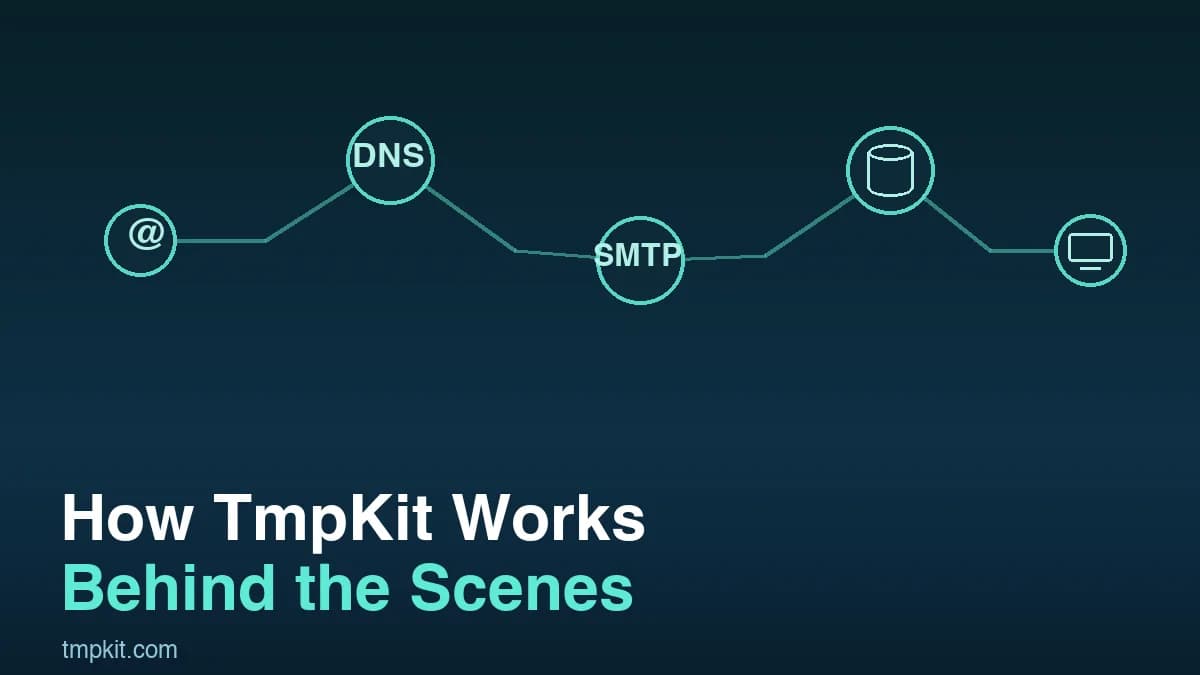
How TmpKit Works Behind the Scenes: Architecture, Go-Guerrilla SMTP, and Ephemeral Storage
Most disposable email services hide behind vague marketing slogans like "military-grade anonymous inbox" without disclosing a single line of their actual technical implementation. In reality, a temporary email service is an exercise in high-throughput network plumbing, distributed session management, strict data sanitization, and defensive domain operations.
TmpKit was built from the ground up to solve a very specific problem: receiving low-risk transactional verification codes without cluttering primary mailboxes or leaking long-term identifiers to data brokers.
In this behind-the-scenes technical breakdown, we pull back the curtain on the entire pipeline—from the moment an external Mail Transfer Agent (MTA) executes a DNS MX query to the sub-second browser polling loop that delivers sanitized email to your screen.
1. End-to-End System Architecture
The following architectural diagram illustrates the complete data flow from outbound sender to browser display:
Sender MTA (e.g. Gmail / SendGrid)
  │
  │  1. Inbound SMTP Connection (Port 25, Opportunistic STARTTLS)
  ▼
[ edge.tmpkit.com:25 ] -> Go-Guerrilla SMTP Daemon
  │
  ├── 2. Header & Body MIME Stream Demuxing
  │      - Enforces Max 10MB message ceiling
  │      - Strips executable attachments (.exe, .bat, .scr)
  │
  ├── 3. Dual-Tier Ephemeral Persistence
  │      ├── Tier A (PostgreSQL): Address, Subject, From, Timestamp, Metadata
  │      └── Tier B (Redis): Compressed Raw MIME / Body with Hard 3600s TTL
  │
  ▼
[ Next.js Edge Web Service ]
  │
  ├── 4. Session Validation (Strict HttpOnly Cookie Matching Recipient)
  ├── 5. Content Sanitization (DOMPurify Allowlist + Tracking Pixel Rewriter)
  │
  ▼  6. Polling & Realtime Event Stream (HTTP Long-Polling / SSE)
Client Browser (Sandboxed <iframe> Display)
2. The Ingestion Engine: Go-Guerrilla SMTP Daemon
Traditional mail servers such as Postfix or Exim were engineered for permanent Unix mailboxes (/var/mail/$USER) with disk-backed Maildir hierarchies. They incur severe file I/O overhead and complex user directory lookups that make them poorly suited for throwaway inboxes.
TmpKit employs a customized deployment of go-guerrilla, an event-driven, non-blocking SMTP daemon written in Go capable of ingesting tens of thousands of concurrent connections on minimal hardware footprint.
How Catch-All Mail Routing Functions
Unlike standard mail servers that require creating a system user or virtual mailbox table in advance, TmpKit configures its domains in catch-all mode. During the SMTP session:
C: EHLO mailer.example.com
S: 250-edge.tmpkit.com Hello mailer.example.com
S: 250-STARTTLS
S: 250-SIZE 10485760
S: 250 8BITMIME
C: STARTTLS
S: 220 2.0.0 Ready to start TLS
[... TLS 1.3 Handshake Negotiated ...]
C: MAIL FROM: <[email protected]>
S: 250 2.1.0 OK
C: RCPT TO: <[email protected]>
S: 250 2.1.5 OK Recipient matched active domain
C: DATA
S: 354 Start mail input; end with <CRLF>.<CRLF>
[... Message Payload ...]
C: .
S: 250 2.0.0 OK: message queued 4f1a8c9b
In the Go backend, the daemon processes the Envelope struct within a pipeline processor:
// Simplified Go-Guerrilla custom Redis+SQL pipeline processor
func SaveToTmpKitStorage(e *backends.Envelope) (backends.Rendered, error) {
    recipient := strings.ToLower(e.RcptTo[0].User + "@" + e.RcptTo[0].Host)

    // Check if the domain is currently hosted on TmpKit
    if !isSupportedDomain(e.RcptTo[0].Host) {
        return backends.NewRendered("554 Transaction failed: Unrecognized domain"), nil
    }

    messageId := generateSecureToken(16)

    // Store message metadata in Postgres for index querying
    go recordMetadataInSQL(messageId, recipient, e.MailFrom.String(), e.Subject)

    // Store compressed payload in Redis with TTL matching active session window
    go cacheMessagePayloadInRedis(messageId, e.Data.Bytes(), 3600*time.Second)

    return backends.NewRendered("250 2.0.0 OK: Message accepted"), nil
}
3. Dual-Tier Storage & Ephemeral Lifecycle Management
One of the most consequential engineering decisions in a privacy-oriented temp mail service is guaranteed deletion. If data lingers on disk or in database backups, the promise of ephemerality is broken.
TmpKit implements a dual-tier storage architecture designed specifically to balance indexing performance against automated garbage collection:
Tier 1: Relational Metadata (PostgreSQL)
- Stores non-confidential routing metadata:
message_id,recipient_address,sender_address,subject_preview,received_at, andexpires_at. - Enables rapid pagination and index scans when the frontend polls
GET /api/inbox. - An independent background cron executes partitioned truncation:
DELETE FROM email_messages WHERE expires_at < NOW() - INTERVAL '600 seconds';
Tier 2: Compressed Ephemeral Payloads (Redis)
- The raw MIME stream, parsed HTML/plain-text bodies, and inline attachment buffers are stored in memory via Redis.
- Every message payload key is assigned a strict Redis TTL:
SETEX email:payload:4f1a8c9b 3600 "<gzip-compressed-mime-bytes>" - Once the 3,600-second window elapses, the Redis key-eviction mechanism automatically purges the memory block. Even if the SQL background worker experiences transient database locks, the message body evaporates automatically at the memory layer.
4. Client-Side Security: Content Sanitization & Sandboxed Iframes
Allowing untrusted third-party HTML and JavaScript to render directly in a user's web browser is an invitation to Cross-Site Scripting (XSS), session hijacking, and CSRF attacks. Attackers routinely weaponize HTML emails using malicious SVG payloads, javascript: pseudoprotocols, and hidden redirect triggers.
TmpKit implements a strict defense-in-depth isolation boundary:
[Raw Untrusted HTML Payload]
  │
  ▼
[1. DOMPurify Server-Side Sanitizer]
  │ Aggressively strips scripts, form elements, base tags, and event handlers
  ▼
[2. Remote Image & Web Beacon Proxy]
  │ Rewrites tracking pixel URLs to anonymous server-side proxy
  ▼
[3. Browser Native Sandboxed Iframe]
  │ Rendered in <iframe sandbox="allow-popups"> without allow-scripts
Defense 1: Server-Side Allowlist Sanitization
Before HTML is returned to the client, it passes through a rigorous DOMPurify ruleset. All script tags, object/embed wrappers, form elements, base tags, and interactive handlers (onload, onerror, onclick) are aggressively stripped.
Defense 2: Sandboxed Iframe Isolation
The rendered email is placed inside an isolated <iframe> configured with minimal sandbox permissions:
<iframe
  sandbox="allow-popups allow-popups-to-escape-sandbox"
  srcdoc="<!DOCTYPE html><html>...sanitized html...</html>"
  className="w-full border-0 min-h-[400px]"
/>
Notice what is omitted: allow-scripts, allow-same-origin, and allow-top-navigation are deliberately absent. Even if a zero-day sanitization bypass exists, the browser's native iframe boundary prevents the payload from executing JavaScript or reading the parent window's cookies.
Defense 3: Remote Image & Web Beacon Proxy
Email marketers frequently embed 1x1 transparent tracking pixels to log when an email is opened, alongside the reader's IP address, user-agent, and approximate physical location.
To mitigate this vector, TmpKit intercepts and rewrites all <img src="..."> tags:
- Direct tracking URL:
https://tracking.adnetwork.com/beacon.gif?uid=9872 - Rewritten TmpKit URL:
/api/image-proxy?url=https%3A%2F%2Ftracking.adnetwork.com%2Fbeacon.gif%3Fuid%3D9872
When the browser requests the image:
- The request hits TmpKit's proxy worker rather than the sender's ad network.
- The proxy strips the client's
Cookie,Referer, and IP address headers. - The image is fetched server-to-server and streamed back with aggressive cache headers.
5. The Operational Reality: Domain Reputation and The Blocklist Arms Race
Building the software for a disposable mail service is only half the battle. The far more exhausting operational challenge is navigating the global domain reputation ecosystem.
Anti-fraud and identity verification providers maintain continuous automated crawlers that monitor public temp mail services. When a domain is identified as disposable:
- It is appended to public and commercial DNSBL lists (such as Spamhaus DBL or proprietary vendor blocklists).
- Major web applications (e.g., streaming providers, social media platforms, cloud services) reject signups containing that domain at the registration form.
[Step 1: Form Submission]
  User enters disposable address (e.g. [email protected]) on target web service.

[Step 2: Anti-Fraud Verification]
  Registration backend queries third-party fraud detection API or DNSBL cluster.

[Step 3: Blocklist Match]
  Detection engine resolves domain MX record or matches static blacklist: DISPOSABLE_MATCH.

[Step 4: Form Rejection]
  Web app halts signup: "Please provide a valid permanent or business email address."
To provide full transparency on this arms race:
- We publish our Disposable Domain Observatory, documenting the exact dataset (7,892+ curated disposable domains) used by our detection engine.
- We maintain the Disposable Domain Checker to help developers and system administrators audit whether a given domain is flagged in industry databases.
6. Verifiable Engineering Principles
TmpKit's implementation adheres to transparent, verifiable rules:
- Zero Outbound Capability: We maintain no SMTP submission servers (
ports 465/587). We cannot send or relay email. - Strict Cryptographic Entropy: Session keys are generated via 16 cryptographically secure random bytes (
crypto/rand), preventing address enumeration. - Hard Expiry Windows: Messages strictly expire after 60 minutes unless explicitly extended once by the user.
For more technical and compliance details, explore our Code-Level Methodology or review our Email Header Analyzer and SPF Checker developer tools.